
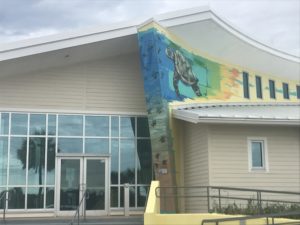
 We had talked about this trip for almost a year and it was finally happening!!
We are volunteers at Bon Secour National Wildlife Refuge and Share the Beach, Alabama’s sea turtle conservation program. We also teach about sea turtles at Marine Science Adventures. A big part of our lives and work is sea turtles but there was one aspect of this amazing reptile’s life we had not experienced, a mama turtle coming to shore to lay her eggs.
Archie Carr National Wildlife Refuge has more nesting loggerhead sea turtles than anywhere in the world. Last year they had over 20,000 loggerhead nests on just 20 miles of beach. They also have leatherbacks, greens, and a rare Kemp’s Ridley. In June and July of each year they guide groups through their Sea Turtle Watch Program to watch a mama loggerhead lay her eggs and make her way back into the Atlantic Ocean. We made our reservations online to be a part of a group and then counted down the days until it was time.
The morning of our scheduled tour we headed to our nation’s first National Wildlife Refuge; Pelican Island NWR. We hiked a bit of the Historic Jungle Trail until a volunteer stopped us and told us that we might enjoy the Centennial Trail more. He was right. It’s a beautiful and interesting trail that is lined with wildflowers. The boardwalk features the name and beginning year of every National Wildlife Refuge from the youngest to the oldest. At the end of this trail is an overlook where you can view Pelican Island. Through the provided telescope, we saw white ibises, a juvenile ibis, brown pelicans, great blue herons, and wood storks. Along the path we saw a cotton rat, a black racer, several butterflies, lizards, red velvet ants (cow killers), and a lot of other wasps and hornets.
Before the afternoon storms hit, we hiked Hammock Trail at Sebastian Inlet State Park. Our time was cut short at this park when we discovered that Èva had climbed and hugged trees with poison ivy growing up the sides. Before we left, we saw a huge blue land crab. None of us had ever seen or even heard of one before and were quite surprised by its size. This trail also had a lot of beautiful wildflowers and interesting trees.

We got back to the hotel just as the afternoon storms hit. Fortunately, Eva was able to avoid a major reaction to the poison ivy by scrubbing the infected areas very well with hot water and soap. We walked for a bit along the Atlantic, seeing a white ibis up close, and then rested until it was time for supper. The day was very interesting but we couldn’t wait to see the turtles so we headed out as soon as we could.
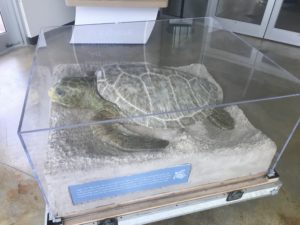
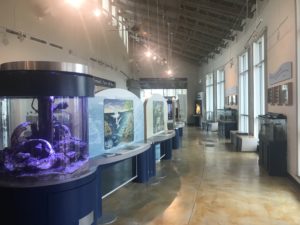
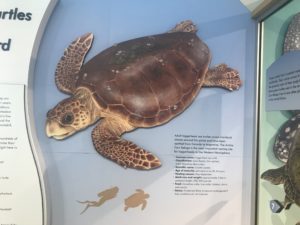 Arriving early was a very good thing because we were able stand on a beach overlook where we saw at least a dozen turtles swimming near the shore. When it was time for our tour, we went into a classroom at the Brevard County Barrier Island Center for a very well done presentation about sea turtles, sea turtle conservation, the work of Archie Carr, and the Refuge itself. Finally it was time to head to the Atlantic to await a mama turtle.
We had just stepped outside when our guide got a call from one of the volunteers that a turtle was on the beach very close to the Center. It didn’t take long for us to spot her but after checking out the area, she decided that wasn’t the place to lay her eggs and we watched her make her way back into the Atlantic. It wasn’t long before our guide got another call that a turtle was digging her egg chamber. It was a long walk and we had to hurry because he was pretty confident that she meant business. By this time is was raining so we hurriedly got into our rain gear as we followed our guide. As Share the Beach volunteers we had no worries about keeping up on a sandy beach but these guides are used to walking up to six miles in a night so we did feel like we had to kick it up a notch.
On the way to our turtle, we stopped to watch another turtle heading into the Atlantic after making a false crawl. This one was closer to us than the first. We also saw others in the water very close to shore.
 When we got to our turtle, the volunteer who was with the nesting turtle had us wait to approach until the turtle was through digging the chamber and started having contractions to eliminate the chance of it being scared away. He had a bright red light on her backside so we could see very well even though it was overcast. Once we were able to approach, it didn’t take long before we saw her drop the first egg. We watched her lay egg after egg, sometimes up to four at a time. She had frequent contractions that were visible to us.
Once our mama turtle was finished laying eggs she started filling in the egg chamber with sand and camouflaging the nest. She did this by throwing sand with her back flippers and maneuvering her body slowly around the body pit. We were surprised at how well she could throw the sand. Her back was mostly covered by the time she was done. Once she threw some so hard that it hit Maureen. Sea turtle flippers have a lot more dexterity than we realized. They actually have knees and we could see them bend as she worked. The five finger-like digits at the end of each flipper helped her greatly. When she started using her front flippers to throw the sand, our guide told us it signaled she was almost done. Sure enough, it wasn’t long before she headed back into the Atlantic. We got back to the Visitor’s Center around midnight.
Some additional information/things we learned:
Female sea turtles mate with several males, even storing sperm in their bodies so they can lay 2-6 clutches per season. One nest can be full of half-siblings.
The turtle would rest every now and then while she was camouflaging her nest and heading back into the Atlantic. She was clearly exhausted from all her hard work.
Even though we were told over and over not to bring cameras or phones, when we got to the turtle walk, we were told that we could take photos as long as we didn’t use white light. Our GoPro would have been perfect and we were disappointed we didn’t have it.
We had hoped to see leatherbacks and greens but their permit only allows them to approach loggerheads with the groups.
Our guide allowed the youngest member of our group, who I think was about 11, to name the turtle. She chose Myrtle.
Even though it was rainy and overcast, it worked out very well because we had cooler temperatures and fewer bugs.
The Visitor’s Center is closed on Mondays. You get to see it just before your tour but the shop isn’t open. We went back the next morning.
We were very glad that we had driven to our meeting spot during the day because at night it is pitch black and very hard to find. If you go, pay close attention to the exact meeting place. It’s south of the Center.
The guide said they have 2-3 groups/year that don’t get a turtle. Also, groups can be cancelled due to inclement weather.
The comeback that sea turtles have made on American beaches is a great conservation success. We still have a lot of work to do but we are thankful for the work of Archie Carr National Wildlife Refuge, The Sea Turtle Conservancy, and other conservation groups like our own Share the Beach that continue to work on the behalf of sea turtles. It was an amazing experience and very much worth the trip.
Thanks for sharing. Wonderful opportunity and great experience. Hope this has enriched your understanding and appreciation for nature.